

Cloud adoption continues to accelerate, but success isn’t guaranteed. Research shows that up to 62% of cloud migration projects either fail or are more difficult than expected, with many unable to deliver the promised business outcomes. (Soocial)
This article explains why cloud migrations fail, explores the biggest cloud migration challenges, highlights common mistakes, and guides you through building a robust cloud migration strategy that prevents failure before you begin.
What Exactly Are Cloud Migration Failures?
Cloud migration failures occur when projects:
- Exceed budget or timelines
- Fail to improve performance or ROI
- Compromise security or compliance
- Disrupt operations or services
In some cases, organizations complete the migration technically but miss the business value they expected, such as cost savings, agility, or innovation gains. (Soocial)
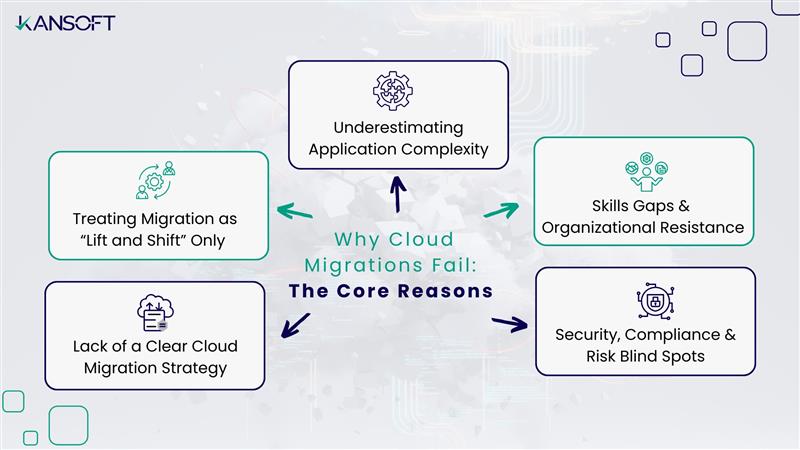
Why Cloud Migrations Fail — The Core Reasons
Lack of a Clear Cloud Migration Strategy
A detailed cloud migration strategy isn’t a nice-to-have — it’s essential. Without defined objectives, scope, and governance, migrations tend to stall or fail. According to industry reports, one of the top reasons cloud migration fails is due to poor planning or absence of a tailored roadmap. (epiuse.com)
Treating Migration as “Lift and Shift” Only
Simply moving workloads to the cloud without redesigning applications leads to inefficiencies. This approach often preserves legacy architecture instead of optimizing for cloud capabilities, resulting in performance issues and higher operational costs.
Underestimating Application Complexity
Many enterprises struggle with hidden dependencies, undocumented systems, and complex integrations. These factors make migration execution challenging and increase risks of downtime or data inconsistency. (CARI Journals)
Skills Gaps and Organizational Resistance
Even with good planning, migrations can fail if teams lack cloud expertise or if there’s poor stakeholder alignment, from developers to business leaders. Change management is an often overlooked requirement for cloud success.
Security, Compliance & Risk Blind Spots
Migrating data and workloads without strong security controls can expose sensitive assets. Compliance with regulations like GDPR or industry-specific standards needs to be baked into the migration plan from day one. (Soocial)
Top Cloud Migration Challenges Organizations Face
Cloud migration challenges often mirror the reasons migrations fail but here’s how they manifest in real projects:
🔹 Cost Management & Budget Overruns
Cloud cost optimization is trickier than many expect. Without monitoring and governance, cloud bills can spiral out of control — a major risk for migrations aiming to reduce IT expenses. (calanceus.com)
🔹 Inadequate Security & Compliance Posture
Cloud environments require different security configurations than on-prem systems. Misconfigured access or data governance can result in breaches or compliance violations.
🔹 Legacy Integration Issues
Outdated systems and lack of integration planning are frequent pain points — causing delays and technical bottlenecks. (Emids)
🔹 Organizational Change Management
Cloud adoption is not just technical; it disrupts established workflows. Organizations that don’t manage stakeholder expectations often encounter pushback and delays.
Common Cloud Migration Mistakes to Avoid
Identifying cloud migration mistakes early can save costs and reduce risks:
-
Skipping Cloud Readiness Assessments
Failing to audit current state infrastructure often leads to misaligned expectations and unforeseen obstacles.
-
Ignoring Optimization Opportunities
A cloud migration should be an opportunity to modernize applications, not just relocate them.
-
Overlooking Testing and Validation
Skipping comprehensive testing before and after migration exposes systems to performance degradation or failures.
-
Not Planning for Post-Migration Operations
Migration is only the beginning; continuous monitoring and tuning are necessary to achieve real benefits.
Understanding Cloud Migration Risks Before You Begin
Cloud migration risks span technical, financial, and operational areas:
- Security vulnerabilities if controls aren’t properly configured
- Downtime and business disruption due to poor sequencing
- Unexpected cost escalation without governance
- Integration gaps between old and cloud systems
In fact, nearly 38% of organizations say cloud migration fails to meet expectations due to skills, planning, or cost issues. (Soocial)
How to Build a Winning Cloud Migration Strategy
A strong cloud migration strategy should act as your roadmap from planning through optimization:
Step 1 – Set Clear Business Objectives
Define what success looks like:
- Cost efficiency
- Innovation enablement
- Scalability and agility
Step 2 – Perform In-Depth Readiness & Dependency Assessments
Understand application dependencies, data gravity, and inter-service connections.
Step 3 – Choose the Right Migration Approach
Evaluate:
- Rehost (lift & shift)
- Re-platform
- Refactor
- Replace
Each has different risks and optimization opportunities.
Step 4 – Integrate Security & Compliance by Design
Include security controls, IAM policies, encryption, and auditing from the start. (Medium)
Step 5 – Continuous Post-Migration Optimization
Track performance, cost, and compliance. Adjust resource allocation dynamically for maximum ROI.
Kansoft’s Approach: How We Help You Avoid Cloud Migration Pitfalls
At Kansoft, we believe strategy determines success. Our cloud migration services don’t just move workloads — we help build a data-driven cloud migration strategy tailored to your business goals. We focus on:
- Strategic planning and cloud readiness assessments
- Risk mitigation and security integration
- Cost governance and performance optimization
- Training and change management for adoption success
Our holistic framework ensures you get cloud outcomes, not just cloud infrastructure.
Cloud Migration Checklist (Before You Start)
Here’s a quick checklist to ensure your migration avoids common failure points:
- Defined business objectives
- Cloud readiness and dependency mapping
- Budget forecast and FinOps plan
- Security & compliance roadmap
- Testing and rollback plan
- Post-migration optimization framework
Conclusion: Prevent Cloud Migration Failures with Strategy
Cloud migration failures are avoidable. With the right planning, governance, and execution, backed by clear business objectives — you can reduce risks, cut costs, and unlock cloud value faster. A strong cloud migration strategy is the foundation that separates successful transformations from stalled or failed projects.
If your organization plans a cloud transition, start with a solid strategy, accurate readiness assessment, and expert support and you’ll be better positioned to avoid the pitfalls that derail so many migrations today.