

Your enterprise just invested $10 million in AI transformation. Six months later, your pilot projects can’t move beyond the sandbox environment. The models perform beautifully in development but collapse in production. Your data scientists spend 80% of their time wrestling with data instead of building models. Sound familiar?
You’re not alone. McKinsey’s latest research reveals that while 88 percent of organizations now regularly use AI, approximately two-thirds remain stuck in experimentation or piloting stages, with only about one-third having begun to scale their AI programs. The culprit isn’t the technology itself it’s the architectural foundations no one wants to talk about.
The Hidden Architecture Crisis
When AI initiatives fail to scale, executives typically blame the usual suspects: insufficient budget, lack of talent, or immature technology. But these are symptoms, not root causes. The real problem lies deeper, in the enterprise architecture best practices that were either never implemented or have been systematically neglected over decades of technical debt accumulation.
According to research from BCG, 89% of C-level executives globally have ranked AI and generative AI among their top three strategic priorities for 2024. Yet this enthusiasm masks a fundamental disconnect: organizations are pouring resources into AI without addressing the architectural problems that will inevitably strangle these initiatives.
The pattern is predictable. A promising pilot demonstrates value in a controlled environment. Stakeholders get excited. Investment flows. Then reality hits: the model needs data from 47 different systems with 12 different definitions of “customer.” Integration takes 18 months. Security teams raise red flags. Compliance becomes a nightmare. The project stalls, and eventually, everyone moves on to the next shiny initiative. As a leading digital transformation company, Kansoft has witnessed this scenario countless times across industries—from manufacturing and healthcare to fintech and e-commerce. The company specializes in helping enterprises navigate these exact
challenges through comprehensive enterprise integration services, AI consulting, and data analytics solutions.
Problem #1: The Data Architecture Nightmare
Data is the foundation of AI, yet most enterprises discover too late that their data architecture resembles less a well-engineered system and more an archaeological dig site with layers of accumulated technical debt.
Consider a large financial institution attempting to deploy credit risk AI models. During the pilot phase, data scientists worked with a clean, curated dataset that delivered impressive results. But scaling required integrating customer data scattered across legacy mainframes, cloud databases, department-specific applications, and third-party systems. Each system had its own definition of fundamental entities like “customer,” “account,” and “transaction.”
The result? An 18-month delay and $50 million in additional costs before the first model could be deployed to production. And this wasn’t an outlier—it’s the norm when enterprises lack proper data architecture foundations.
Enterprise Architecture Best Practices for Data Foundations
Implement Master Data Management (MDM) as Priority Zero
Before investing heavily in AI models, establish golden records for critical business entities. A robust MDM strategy creates a single source of truth that eliminates conflicting definitions and reduces integration complexity. Modern MDM isn’t just about creating a centralized database—it’s about establishing data governance frameworks with clear ownership, quality standards, and automated monitoring.
Adopt a Data Fabric or Data Mesh Architecture
Traditional centralized data warehouses can’t keep pace with modern AI demands. A data fabric provides a unified data access layer across hybrid environments, enabling real-time data availability for ML pipelines while maintaining governance and security. Alternatively, data mesh architectures distribute data ownership to domain experts who treat data as products with clear SLAs and quality commitments. Kansoft’s approach to data infrastructure includes working with industry-leading storage technologies like HPE 3PAR, Dell EMC, NetApp, and Hitachi Vantara to deliver customized, performance-driven storage solutions that ensure reliable performance, reduced downtime, and better cost-efficiency for both on-premise and cloud environments.
Integrate DataOps from Day One
Treat data pipelines as production code with the same rigor applied to software development. This means version control for datasets, automated testing for data quality, continuous monitoring, and rapid alerting when issues arise. According to Gartner, scaling AI requires embracing composability in architecture and decoupling models from engineering tools, infrastructure, and the UX layer.
Problem #2: Integration Hell and API Chaos
Every AI project requires data from multiple systems. In organizations without proper integration architecture, this means custom point-to-point connections that multiply complexity geometrically. A healthcare enterprise with 200+ applications discovered that each AI initiative required custom integrations with 15-30 systems, resulting in six months of integration work for every two months of model development. The changing landscapes of enterprises bring in dynamic integration requirements. As businesses grow and develop, IT architecture becomes more intricate and demanding and needs an ecosystem where different systems seamlessly talk to each other and remain connected.
Enterprise Architecture Best Practices for Integration
Establish API-First Architecture
Create enterprise-wide API governance with standardized templates for REST, GraphQL, or gRPC interfaces. Deploy an API gateway that provides centralized management, security, monitoring, and rate limiting. This transforms integration from a per-project problem into a reusable enterprise capability. Kansoft provides versatile enterprise integration offerings like Mobile, SaaS, Cloud and APIs that give businesses the power to drive operations, increase efficiency through robust data connectivity and empower them to connect across multiple endpoints. Their integration services include seamless connections with SAP, CRM systems, Azure, and various payment gateways like Adyen, ensuring end-to-end payment capabilities and business workflow consistency.
Implement Event-Driven Architecture
Decouple systems using event streaming platforms like Apache Kafka. This enables real-time data flow essential for ML inference while eliminating tight coupling between systems. Event-driven patterns also support the asynchronous nature of AI workloads more naturally than traditional request-response architectures.
Modernize Legacy Systems Strategically
Rather than attempting big-bang replacement of legacy systems, apply the strangler fig pattern: gradually replace functionality while maintaining operational continuity. Build anti-corruption layers that protect new systems from legacy constraints while exposing legacy capabilities through modern APIs. Kansoft’s team of integrators has adopted new technologies to ensure a smooth
functioning process and meet business requirements right from designing, development, to deployment, including connecting on-premise applications with cloud applications to build integrated software solutions.
Problem #3: The MLOps Maturity Gap
A retail giant with 50+ data scientists and hundreds of models discovered that only 15% of models ever reached production, and those that did took 9-12 months to deploy. The organization had invested heavily in data science talent but neglected the engineering infrastructure needed to operationalize AI at scale.
Deloitte’s State of GenAI in the Enterprise Q3 2024 report found that over 70% of organizations have implemented only one-third of their GenAI projects, underscoring the difficulty of achieving enterprise-wide AI adoption.
Enterprise Architecture Best Practices for MLOps
Build ML Platform Infrastructure
Deploy a centralized feature store that enables feature reusability across projects. Implement model registries with comprehensive versioning. Establish experiment tracking that ensures reproducibility. These platforms transform AI from artisanal craft into industrial engineering.
Establish Model Governance Frameworks
Create model risk management processes aligned with regulatory requirements. Implement automated testing for bias and fairness. Require explainability for high-risk models. These aren’t bureaucratic overhead; they’re essential architecture that prevents costly failures and regulatory violations.
Design for Production from Day One
Separate online inference architecture from batch processing. Deploy model serving infrastructure with proper monitoring for data drift and model performance degradation. Implement A/B testing capabilities and canary deployments. Most importantly, integrate DataOps with MLOps to maintain end-to-end lineage from raw data to production predictions. Kansoft’s AI Consulting and Development services help businesses assess their needs and processes to pinpoint areas where AI can deliver transformative results.
Their team of AI specialists designs and builds bespoke AI-powered solutions tailored to specific challenges, ensuring smooth integration within existing infrastructure to maximize business impact.
Problem #4: Cloud Strategy Incoherence
A manufacturing enterprise proudly proclaimed its “multi-cloud strategy,” but the reality was unplanned cloud sprawl across AWS, Azure, and GCP. With no centralized visibility, the organization spent $40 million annually on cloud services with an estimated 35% waste. Data gravity issues prevented efficient model deployment, and vendor lock-in occurred without capturing any benefits of deep integration.
Enterprise Architecture Best Practices for Cloud and AI
Define a Clear Cloud Operating Model
Establish a Cloud Center of Excellence (CCoE) with cross-functional leadership. Implement FinOps practices for cost optimization. Deploy landing zones with security and compliance built in from the start. Choose between multi-cloud, hybrid, or strategic single-cloud based on actual requirements—not vendor pitches or departmental preferences.
Design for Data Sovereignty and Locality
Understand regulatory requirements for data residency. Build hybrid architectures that keep sensitive data on-premises while leveraging cloud for compute-intensive training. Implement data synchronization strategies that balance compliance with performance.
Adopt Cloud-Native AI Patterns
Containerize workloads with Kubernetes for portability and scalability. Use serverless architectures for event-driven inference. Implement proper GPU/TPU resource management to optimize costs. Consider edge ML for low-latency requirements and federated learning for privacy-sensitive scenarios.
The Organizational Architecture Problem
Here’s an uncomfortable truth: your technical architecture mirrors your organizational structure. If your teams are siloed, your systems will be siloed. If business units don’t communicate, their systems won’t communicate. Conway’s Law isn’t just an observation; it’s a constraint that shapes every architectural decision.
MIT CISR research found that enterprises moving from stage 2 (pilots and capabilities) to stage 3 (scaled AI ways of working) see the greatest financial impact, but this transition requires united top leadership, particularly the CEO, CIO, chief strategy officer, and head of human resources, to drive organizational change.
Successful AI scaling requires cross-functional teams that combine business expertise, data science capabilities, and production engineering skills. It demands executive sponsorship that’s more than ceremonial. It needs architecture review processes that balance governance with agility.
A Practical Assessment Framework
Before embarking on expensive transformation initiatives, honestly assess your current state across five critical dimensions:
Data Architecture Maturity: Do you have data cataloging, master data management, quality scores above 95%, feature stores in production, and automated lineage tracking?
Integration Architecture: Are enterprise API standards defined and enforced? Do you have centralized API gateways, event-driven capabilities, and high integration reusability?
MLOps Maturity: Have you standardized ML development lifecycles, automated ML pipelines, implemented production monitoring, established governance frameworks, and reduced time-to-production to under four weeks?
Cloud Architecture: Is your cloud strategy clearly documented? Are governance and FinOps operational? Do you have proper landing zones and workload placement strategies with minimal waste?
Organizational Alignment: Are cross-functional AI teams established? Is enterprise architecture empowered? Are review processes operational? Do you have active skills development and executive sponsorship?
Score yourself honestly on each dimension. Organizations scoring below 15 out of 25 face a high risk of scaling failure and need immediate architectural intervention. Those in the 15-19 range have good foundations but specific gaps to address.
Getting Started: Your 90-Day Action Plan
The journey to proper enterprise architecture begins with three months of focused action:
Month 1: Assess and Align. Complete the architecture assessment. Inventory all AI initiatives and their blocking issues. Document the current state architecture. Present findings to executives and secure sponsorship for transformation.
Month 2: Establish Governance and Quick Wins. Create an architecture review board with clear authority. Define architectural principles and standards. Launch 1-2 pilot initiatives that demonstrate value while building organizational confidence.
Month 3: Scale and Roadmap Design target architecture for key capabilities. Evaluate and select platform technologies. Create a detailed 12-24 month implementation roadmap with measurable milestones and success criteria.
The Competitive Imperative
Organizations that invest in architectural excellence gain compounding advantages. Early architectural investments pay dividends across all future initiatives. Reusable platforms and patterns accelerate every subsequent project. Innovation velocity becomes sustainable rather than sporadic.
The enterprises that successfully scale AI don’t have fewer problems; they have better architecture to solve them and the right partners to implement it. They’ve stopped treating architecture as technical overhead and started recognizing it as a strategic foundation with expert guidance from proven transformation partners.
The window for catching up is narrowing. As architectural leaders deploy advanced capabilities, the gap between those with solid foundations and those building on technical debt grows wider. The question isn’t whether your enterprise will encounter these architecture problems; it’s whether you’ll address them proactively or reactively.
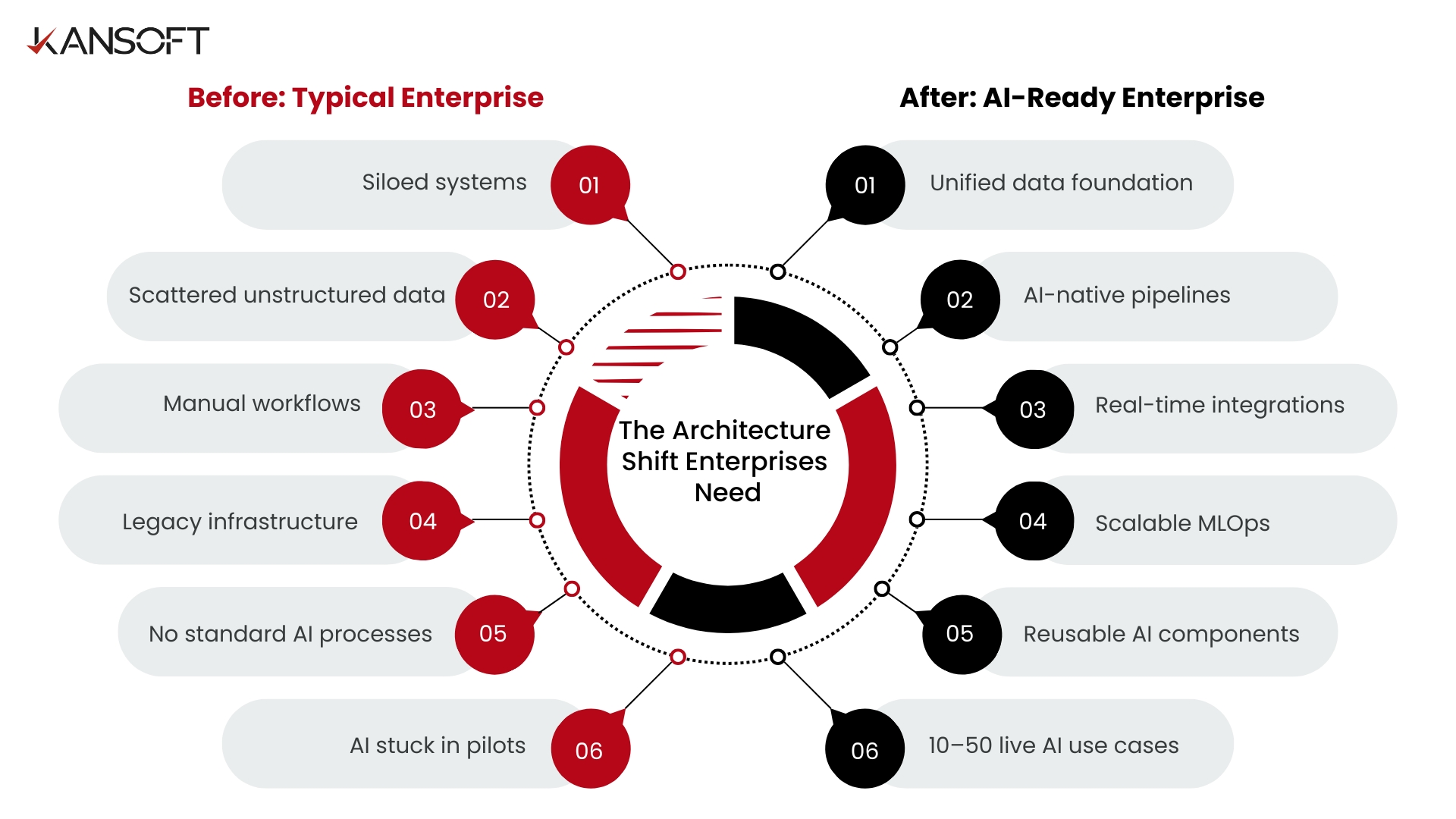
Enterprise architecture best practices aren’t about perfection; they’re about creating foundations that enable iteration, learning, and scale. They’re about transforming AI from expensive experimentation into a strategic capability. The choice is yours: continue investing in initiatives that can’t scale, or partner with Kansoft to build the architecture that makes scale inevitable.